

Glossary
Gajendra
Brief description of the Hindu legend is as follows.
Gajendra was an elephant king. One day he went to a lake and stepped into it. A crocodile caught hold of his leg and would not leave it inspite off strenuous efforts by the elephant to free himself. At last in vain, Gajendra called out fervently to the god Vishnu to save him. The Lord heard Gajendra’s prayers and saved him from the crocodile.Gandharva
Gandharva is a name used for distinct heavenly beings in Hinduism and Buddhism.
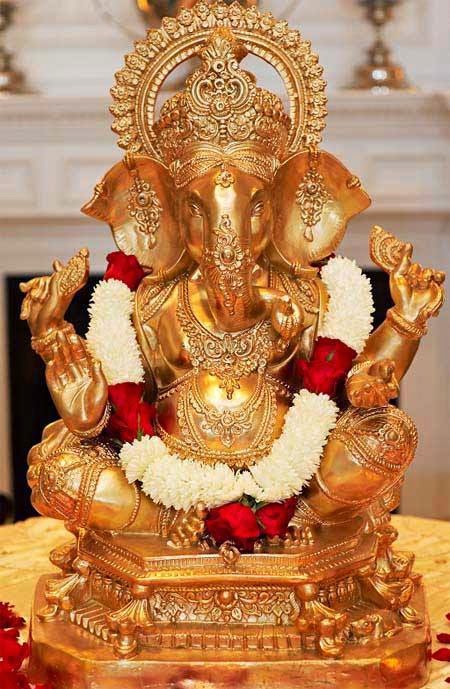
Ganesha
Also popularly known as Vinaayaka, although he is known by many attributes, Ganesha’s elephant head makes him easy to identify. Ganesha is widely revered as the remover of obstacles, the patron of arts and sciences and the Lord of intellect and wisdom. As the God of beginnings, he is honoured at the start of rituals and ceremonies. Ganesha is also invoked as patron of letters and learning during writing sessions.
Gayatri
Gayatri is from the Rig Veda of the Hindu culture.
Meaning:
The beginning, middle and end of all beings (OM),
The Illuminator of the Earth, Interspace and Heavens,1
I meditate upon That Great Venerable Adorable Sun.
May that self-luminous, radiant and divine Light,
illumine and inspire my intellect in the right direction.1 Symbolically they mean the Waking, Dream and Deep Sleep states.
The Gayatri mantra in Devanagari:
ॐ भूर्भुवः स्वः ।
तत्स॑वि॒तुर्वरेण्यं॒
भर्गो॑ दे॒वस्य॑ धीमहि ।
धियो॒ यो नः॑ प्रचो॒दया॑त् ॥om bhūr bhuvaḥ svaḥ
tát savitúr váreṇyaṃ
bhárgo devásya dhīmahi
dhíyo yó naḥ prachodayāt
– Rig Veda (Mandala 3.62.10)Geeta
~~
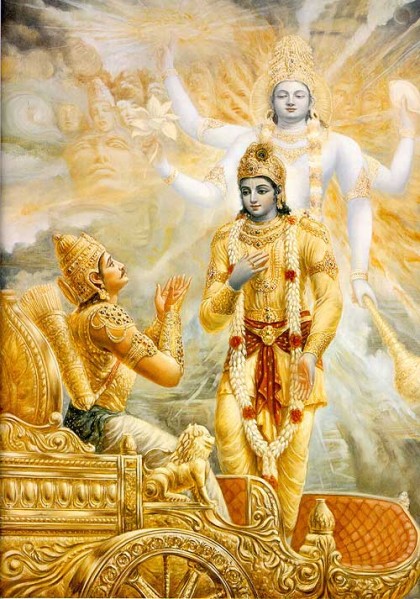
The Bhagavad Gita is a 700-verse Hindu scripture in
Sanskrit that is part of the Hindu epic Mahabharata.
The Gita is a dialogue between Pandava prince
Arjuna and his guide and charioteer Lord Krishna.
Arjuna faces the duty as a warrior to fight a
righteous war between Pandavas and Kauravas. Lord
Krishna guides him to fulfill his duty and establish
Righteouness. He also offers methods toward the
attainment of Liberation through Jnana, Bhakti,
Karma, and Raja Yogas.
Genie
Genie is a spirit of Arabian
folklore, as traditionally depicted
imprisoned within a bottle or oil
lamp, and capable of granting wishes
when summoned.Origin:
mid 17th century (denoting a guardian
or protective spirit): from French
génie, from Latin genius (see genius).
Génie was adopted in the current
sense by the 18th-century French
translators of The Arabian Nights’
Entertainments, because of its
resemblance in form and sense to
Arabic jinnī ‘jinni.’
Gopuram
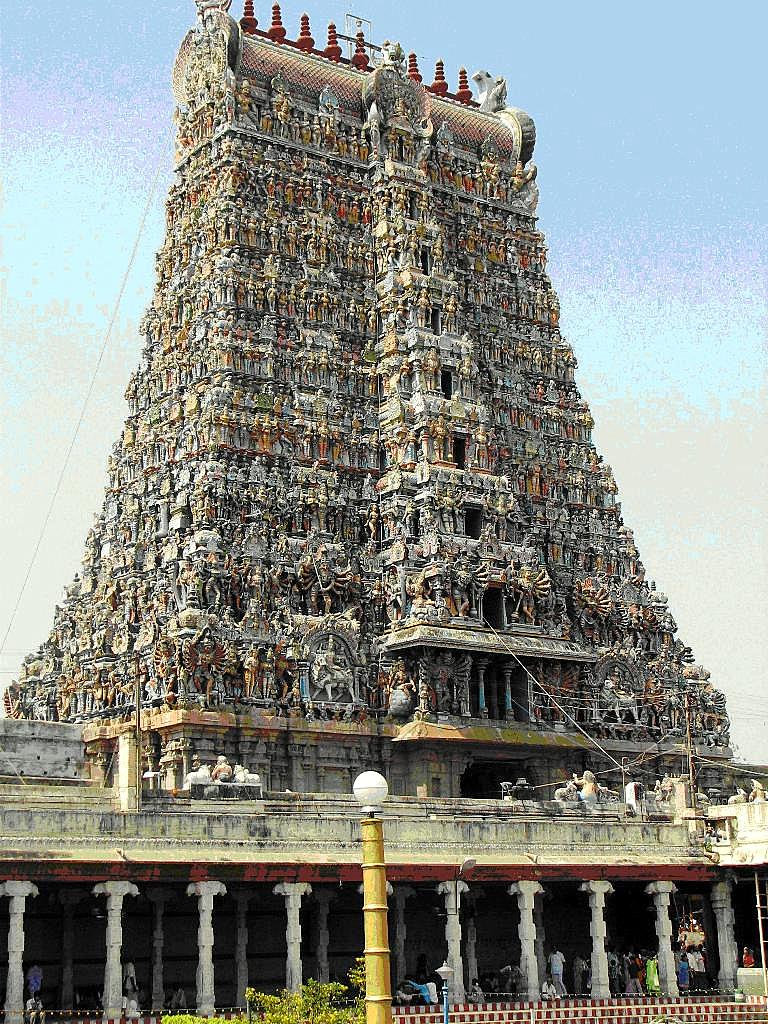
Gopuram is a monumental tower,
usually ornate, at the entrance
of any temple, especially in
Southern India.
This forms a prominent feature of
‘Koil’s, the Hindu temples of the
Dravidian style.
Gopuram
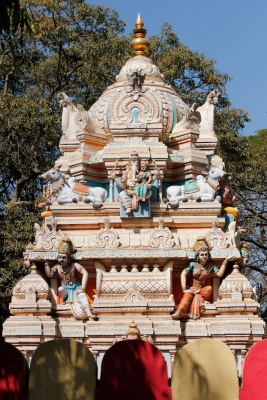
Goddess Sri Meenakshi Temple Tower
Grihastha Dharma
~~~
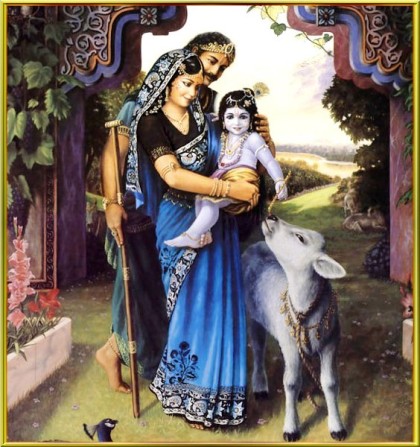
The duties of a householder.Grihi
Householder; one who leads a
life with a home and family.Grihini
Housewife; a woman who performs the duties of
a householder
Grihini Gunas
Guṇa, depending on the context means ‘string,
thread or strand’, or ‘virtue, merit, excellence’,
or ‘quality, peculiarity, attribute, property’.There are three guṇas. They are called:
sattva (goodness, constructive, harmonious),
rajas (passion, active, confused), and
tamas (darkness, destructive, chaotic).All of these three gunas are present in
everyone and everything, it is the proportion
that is different. The interplay of these gunas
defines the character of someone or something,
of nature and determines the progress of life.In some contexts, it may mean ‘a subdivision,
species, kind, quality’, or an operational
principle or tendency of something or someone.
In human behavior, Guna means personality,
innate nature and psychological attributes
of an individual.Guru
~~~
Guru: a Teacher, Master, an Enlightened Being
particularly in Indian religions. The Hindu
guru-sishya (teacher-student) tradition is the
oral tradition or religious doctrine or experiential
wisdom transmitted from teacher to student. In the
present times, Guru could mean anywhere from an
expert in a certain field to a Spiritual Master.

